
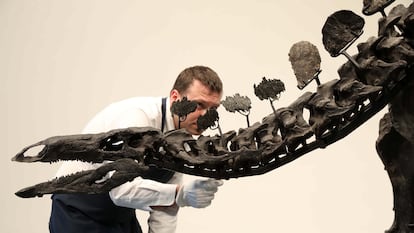
Dinosaur fossils, the latest obsession of the ultra-rich: ‘Some enjoy knowing only they can admire it’
María Victoria Ennis|Buenos Aires|
Paleontological pieces are fetching millions alongside works of art, a trend experts worry will hamper research
Paleontological pieces are fetching millions alongside works of art, a trend experts worry will hamper research
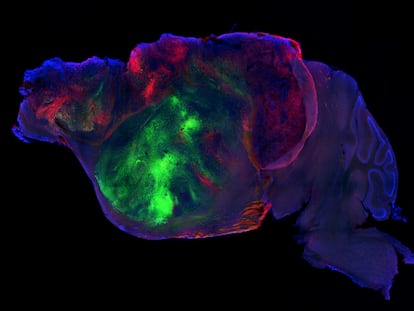
Researchers in the United States and Spain have created living rodents with cerebral cortexes from healthy people to facilitate research into autism, schizophrenia, and epilepsy
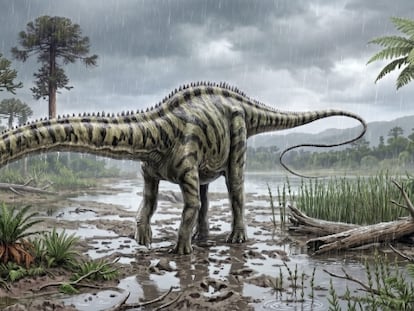
The specimen, uncovered in Teruel, measured 25 meters and lived 150 million years ago
The discoverer of asymmetric organocatalysis defends the discipline’s potential to solve humanity’s greatest problems
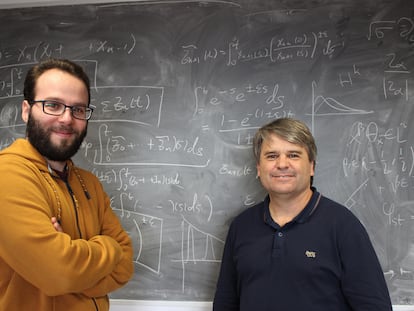
Diego Córdoba and Luis Martínez‑Zoroa’s research is the foundation of the announcement that artificial intelligence has solved one of the greatest enigmas in history. Both believe the achievement will radically change the discipline
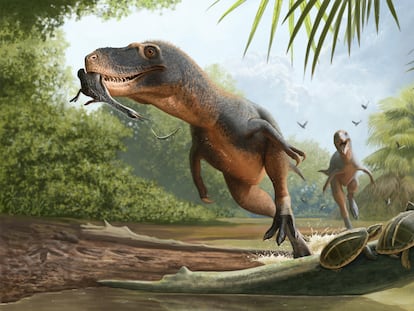
Remains found in the fossilized feces of a theropod show that modern-type feathers had already evolved in other bird lineages 66 million years ago

Artificial intelligence, extraterrestrial life, the climate crisis, the future of work and global governance. This science communicator uses the lens of science to tackle a much broader question: what kind of civilization do we want to be?

The share of the population exposed to tobacco smoke is falling, but more than 2.7 billion people worldwide are still affected

Techniques such as the gene-editing tool CRISPR already make survivals approaching a year possible, something unheard of until recently
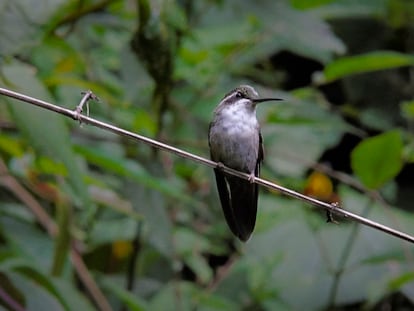
Researchers from the Autonomous University of Campeche, in Mexico, are analyzing samples from these tiny birds in order to reconstruct the chemical history of the area
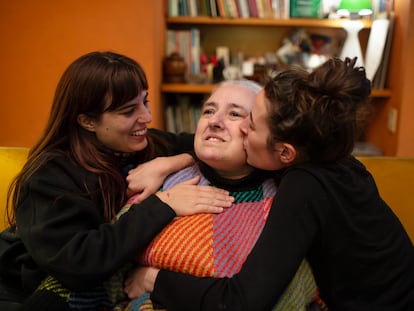
A family in Argentina has become an ideal case to study frontotemporal dementia. Across generations they transmit a mutation in the GRN gene, responsible for producing a protein essential to healthy brain cell function

A series of scientific papers maps the insect’s neural connections in unprecedented detail, opening new avenues for answering some of neuroscience’s biggest questions

A large-scale study analyzing more than a million people has found that the family environment plays a smaller role than previously thought in shaping traits such as curiosity and agreeableness

A large Spain-led study to prevent atherosclerosis seeks to better diagnose cardiovascular risk, which affects one in 13 people aged 18 to 29 without symptoms

As a child she was expected to follow the family tradition on the tennis courts, but now she is a NASA safety expert tasked with transporting astronauts to the lunar surface
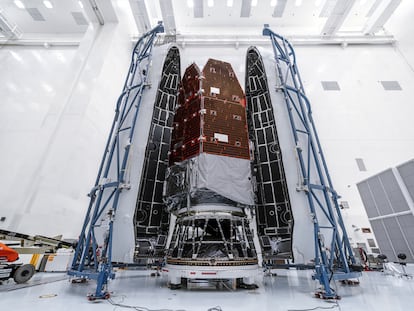
NASA has launched its most ambitious space telescope yet, a mission designed to help answer two of astrophysics’ biggest questions: what are dark matter and dark energy

The astronomical phenomenon was visible in parts of the Americas and Europe. The Earth moved between the sun and the moon, causing part of our satellite’s surface to pass into Earth’s shadow and take on a reddish hue

The so-called ‘blood moon’ will see up to 96% of its visible surface covered during an eclipse that will be visible across the country

The delay in the launch of the Chang’e-7 mission is putting pressure on the timeline as Washington and Beijing race to be the first to reach the Moon’s most coveted area

After decades of setbacks, a treatment for melanoma is very close to being approved
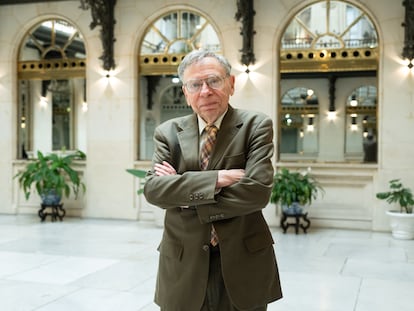
The US researcher is a pioneer in understanding the effects of climate change on the oceans. In this interview with EL PAÍS, he warns about the risks posed by deniers and advocates for international cooperation

After a catastrophe, there are three possible paths, says one of the pioneers of the concept of resilience: carry on as before, vote for a dictator who promises security, or evolve and be reborn
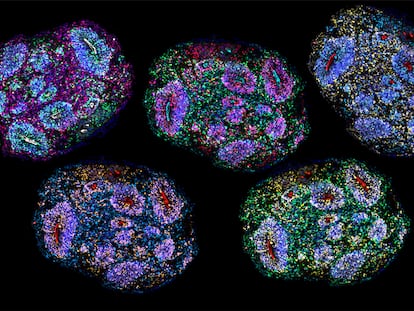
Harvard researchers have developed a model that makes it possible to study the brain at previously inaccessible stages of development, opening the door to more advanced research into diseases and potential treatments

An analysis of documents from 200 years ago reveals the high fatality rate of the outbreak, which was not bubonic, and the effectiveness of quarantine measures
There are doctors, neuroscientists and physicists who believe science can prove life after death, although for most this remains a matter of faith rather than laboratory work

The Finnish researcher was recently awarded the Körber European Science Prize for changing the way we understand cell biology

Curiosity, emotion and paying attention shape our perception of time. This is why time flies as we grow older